
Home › Blog › Art and culture classes
Best Painting Class in Da Nang: What to Know Before You Book
By the Cáo Experiences team · 2026-11-06
A painting class in Da Nang is a hands-on workshop where you learn technique, composition and colour theory in a small group or private setting. Most beginner sessions at Cáo Experiences run 2–3 hours in a light-filled studio or a host's home art space, with all materials included and instruction in English. You'll start with basic mark-making or still-life study, then move to your own small canvas or paper work—no prior skill needed. The pace adapts to whether you're a complete beginner, a rusty returning painter, or someone with some experience. Private sessions suit couples, families and those nervous about group settings. Group classes (typically 4–8 people) cost less per person and create a collaborative energy. Ask us for dates and a quote on WhatsApp to compare options for your dates and group size. Ask about dates on WhatsApp
What's the difference between group and private painting sessions?
Group sessions in Da Nang typically bring 4–8 people together in one space, with one instructor managing the room. You share materials, watch others work, and benefit from peer energy—many people paint better with company. Private sessions are just you (or you and a partner, or a small family), so the instructor adapts every instruction to your pace and what you want to paint. Groups cost less per head and suit people who are confident in social settings; private sessions suit nervous beginners, families with young kids, and those with specific goals. Both formats run the same 2–3 hour length.

Who should take a painting class, and when?
Painting classes work for complete beginners with zero prior art experience, people who painted years ago and want to restart, and kids aged 7 upwards with an adult. They suit couples looking for a shared afternoon, families wanting a slow activity together, and small groups of friends or colleagues wanting a team experience. Seniors enjoy the pace and the chance to learn without pressure. You don't need to be "artistic" or have steady hands—we adapt to tremor, arthritis, or vision limits. The best time is when you have 2–3 uninterrupted hours and genuinely curious energy. Avoid booking if you're exhausted, jet-lagged, or hoping art will fix a difficult mood—you'll paint better when you're rested and open.
What do you actually paint in a beginner session?
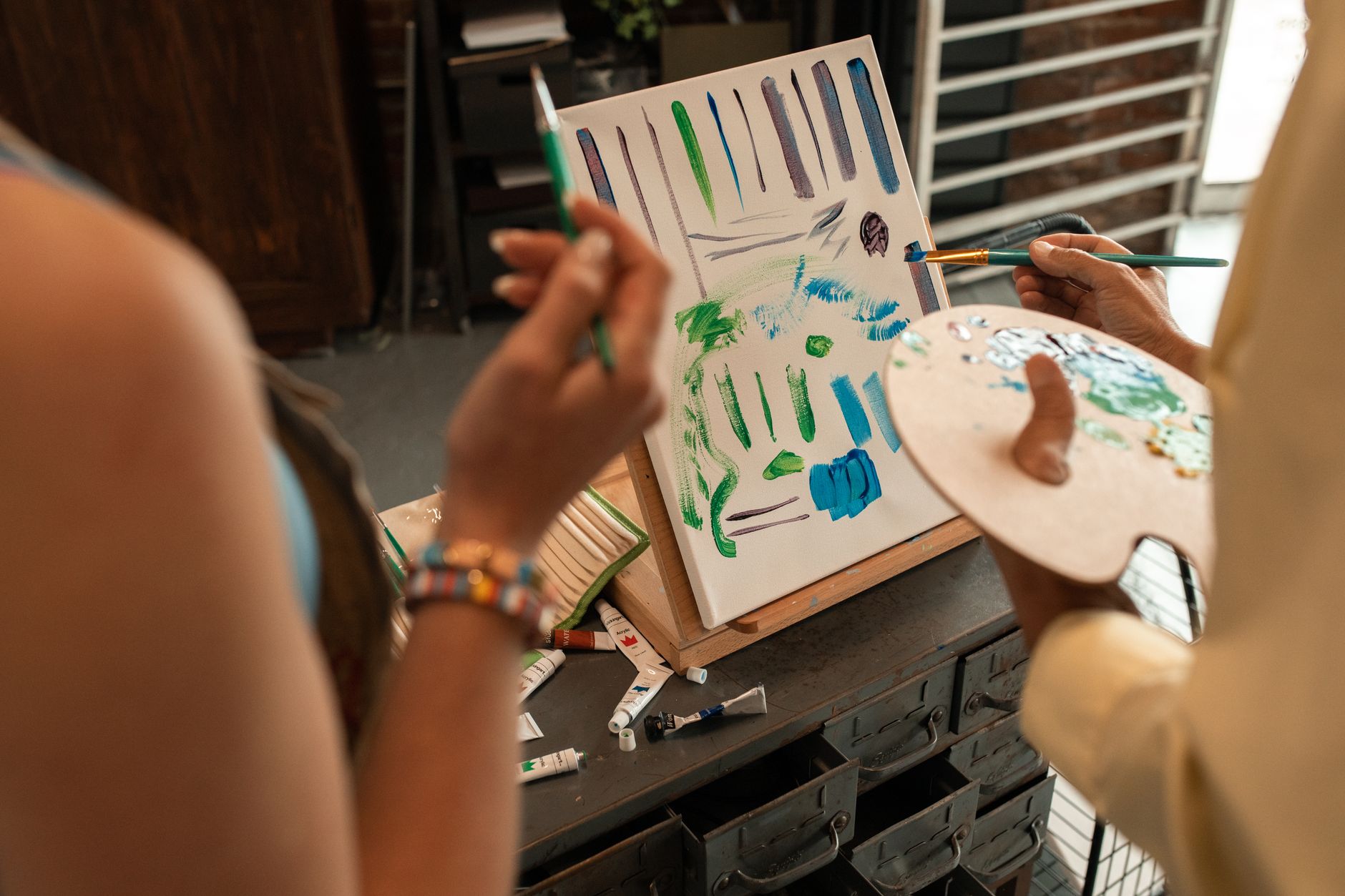
In your first 30 minutes, we move you from "what do I even hold?" to your first confident marks. You'll learn grip, brush angle, how water and pigment behave, and the feeling of mixing colours. Then we do a short still-life study—maybe a vase, fruit, or a simple object—so you practice seeing tone and shape. After that, you choose: some people paint a small landscape they remember, others do an abstract study, others continue the still-life with more detail. By the final hour, most people have a small finished work they're proud of—nothing gallery-ready, but genuinely theirs. We frame one or two pieces on the wall before you leave so you can photograph it. Kids often paint animals, their family, or favourite places; they finish faster and we usually do a second piece.
How do weather and allergies affect a Da Nang painting class?
Da Nang's rainy season runs May–September; during heavy rain, we host indoors in a covered studio or a host's home art space with good natural light and ventilation. Indoor sessions feel quieter and more intimate—people often focus deeper without street noise. Acrylic paint (our default) is water-soluble, so brushes and hands wash clean even on humid days; we always have a sink and clean towels. If you have asthma or paint-fume sensitivity, tell us during booking on WhatsApp and we'll use odour-free, low-VOC acrylics and ensure cross-ventilation. Allergies to specific pigments are rare but possible—mention them upfront. Pregnant people paint safely with acrylics; we just avoid any pressure on the abdomen, so no standing at tall easels for hours. Seniors and anyone with joint stiffness can paint seated at a table; we adapt easel height, brush grip, and pace without comment.
What should you check and bring before booking?
Ask us these questions before you pay: How many people will be in my group? (so you know if it's intimate or social). Where exactly do we meet? (we host in various Da Nang locations; ask for the full address and parking info). What medium—acrylic, watercolour, or mixed? (we default to acrylic for speed and forgiveness, but watercolour works if you want it). Are all materials included, or do I buy extras? (all paints, brushes, water, paper and canvas are provided; you bring nothing except water and a snack). (ask us on WhatsApp for exact terms). Can I take my finished work home the same day? (yes, but acrylic needs 30 minutes to dry fully; we'll bag it safely). Wear clothes you don't mind getting paint on—acrylics wash out of most cotton and linen, but not all. Bring a water bottle, a notebook if you like jotting down colour mixes, and an open mind.
How does a painting class compare to other art experiences in Da Nang?
| Experience | Duration | Group size | Best for | Hands-on? |
|---|---|---|---|---|
| Painting class | 2–3 hours | 1–8 people | Beginners, families, couples | Full |
| Craft workshops | 2–4 hours | 2–10 people | Skill-building in textiles, pottery, carving | Full |
| Art and culture classes | 1–3 hours | 4–12 people | Art history, technique, context | Medium |
| Flower arranging | 2 hours | 2–6 people | Design, colour, gift-making | Full |
| Private tutoring | 1–2 hours | 1 person | Advanced goals, portfolio prep | Full |
Painting classes focus on mark-making, colour, and speed—you finish a piece in one session. Other craft workshops go deeper into one skill (like indigo dyeing or hand-weaving); they often run multiple sessions. Flower arranging overlaps on colour theory but teaches design for a living arrangement. If you want the full art story—history, context, critique—a art and culture class suits better. Most people do a painting class first because it's low-pressure and fast.
What mistakes do first-timers make, and how do we help?
Mistake 1: Waiting too long before starting. Beginners often spend 20 minutes staring at a blank canvas. We sketch lightly in pencil first so you have a map—takes the pressure off. Mistake 2: Using too much water. Acrylics are forgiving if pigment stays thick; too thin and they look weak. We show you the right paint-to-water ratio in the first 5 minutes. Mistake 3: Blending too much. People expect smooth gradients like photographs; acrylics dry fast, so two or three layers of colour side-by-side often looks better. Mistake 4: Choosing a painting too ambitious. A complex landscape or portrait can feel unfinished in 3 hours. We steer you toward simple subjects—one vase, three fruits, a door, a window—so you finish proud. Mistake 5: Being silent. Nervous people paint in total quiet and miss questions. We create space for chat; talking actually helps you see better.
See how a session runs
How does Cáo Experiences run a painting session differently?
We host in real, lived-in spaces—a host's home studio with a view, a light-filled courtyard, a quiet lane in Da Nang's old quarter—not a sterile art school. That changes the energy: you're learning from someone who paints for themselves, not delivering curriculum. Instruction is in English, adapted live to your pace. If you finish early, we do a second piece or go deep on technique. If you're still working at hour three, we let you finish. We don't enforce "rules"—if you want to use every colour on one brush and see what happens, that's valid exploration. Kids don't get talked down to; they paint alongside adults. Seniors aren't rushed. We photograph your work and send it to you afterwards so you have a memory. And if you want to return—for a second session to build on what you learned, or to try flower arranging or a different craft workshop—we remember exactly where you left off.
What to check before you book
| Question | Why it matters | How to find out |
|---|---|---|
| How many sessions before I see real progress? | Realistic goal-setting | Ask us on WhatsApp for typical timelines |
| What if I hate what I painted? | Manage expectations | Reframe: "bad" paintings teach the most |
| Can I do this with my kid / partner / elderly parent? | Group dynamics | Tell us ages and mobility in your WhatsApp message |
| Do I need to book weeks in advance? | Availability in Da Nang | Ask us for current open dates |
| What if the weather is very hot or rainy? | Comfort & safety | We host indoors or move to a covered space |
| Can I bring my own paints or brushes? | Consistency and waste | Not needed; ours are good quality and included |
Next steps
Painting in Da Nang is most rewarding when you book a session that fits your dates, group size and comfort level. We offer private sessions, small group classes, and family options—each adapted to beginners. The best way to find your fit is to message us on WhatsApp with your dates, how many people, and whether you prefer a group or private setting. We'll suggest times, confirm the location, and answer any questions about materials or accessibility.
We also run family experiences that include painting for younger kids, group and corporate painting team-building, and wellness slow-art sessions for people seeking calm. If you're exploring Da Nang more broadly, our street food and market tour, Vietnamese coffee workshop, and other experiences in Da Nang pair well with an art class for a full creative day.

FAQ
Do I need to be able to draw to take a painting class?
No. Drawing and painting are different skills. You'll use pencil to sketch lightly at the start, but the focus is on colour, tone and brushwork. Many confident painters can't draw, and many drawers are timid painters. We start from mark-making, not drawing ability.
What if I get paint on my clothes or skin?
Acrylic paint washes out of most cotton, linen and skin with soap and water—it's water-soluble until it dries. Wear clothes you don't mind staining just in case. We provide an apron, but splashes happen. Dried acrylic is permanent, so rinse quickly if you spill on something you love.
Can kids under 7 join a painting class?
Children 7 and older engage well with 2–3 hour sessions. Under 7, they tire and lose focus, and acrylic paint in eyes or mouth is a risk. For younger kids, ask us about family experiences with shorter, play-based art activities adapted to their age.
How long until my painting is totally dry?
Acrylic dries to the touch in 15–30 minutes on paper, longer on thick canvas. We let it dry during class; you can handle it gently by the end. To be fully cured (hard, no smudging), leave it flat for 24 hours. We bag it carefully for transport.
What if I want to keep learning after one session?
Book a second session and we'll build on what you learned—colour mixing, composition, or a new medium. Many people do 2–4 sessions over weeks or months. You can also try craft workshops or flower arranging to explore other hands-on skills.
Can I book a private session for just two people?
Yes. Private sessions work beautifully for couples, a parent and child, or two friends. We adapt the space, pacing and subject matter to your two-person dynamic. Message us on WhatsApp with your dates and we'll quote you.
Ask about dates
Tell us the city, your dates and what you would like to try. We reply on WhatsApp in English with options and availability.
FAQ
Do I need to be able to draw to take a painting class?
No. Drawing and painting are different skills. You'll use pencil to sketch lightly at the start, but the focus is on colour, tone and brushwork. Many confident painters can't draw, and many drawers are timid painters. We start from mark-making, not drawing ability.
What if I get paint on my clothes or skin?
Acrylic paint washes out of most cotton, linen and skin with soap and water—it's water-soluble until it dries. Wear clothes you don't mind staining just in case. We provide an apron, but splashes happen. Dried acrylic is permanent, so rinse quickly if you spill on something you love.
Can kids under 7 join a painting class?
Children 7 and older engage well with 2–3 hour sessions. Under 7, they tire and lose focus, and acrylic paint in eyes or mouth is a risk. For younger kids, ask us about [family experiences](/family-experiences) with shorter, play-based art activities adapted to their age.
How long until my painting is totally dry?
Acrylic dries to the touch in 15–30 minutes on paper, longer on thick canvas. We let it dry during class; you can handle it gently by the end. To be fully cured (hard, no smudging), leave it flat for 24 hours. We bag it carefully for transport.
What if I want to keep learning after one session?
Book a second session and we'll build on what you learned—colour mixing, composition, or a new medium. Many people do 2–4 sessions over weeks or months. You can also try [craft workshops](/craft-workshops) or [flower arranging](/flower-arranging) to explore other hands-on skills.
Can I book a private session for just two people?
Yes. Private sessions work beautifully for couples, a parent and child, or two friends. We adapt the space, pacing and subject matter to your two-person dynamic. Message us on WhatsApp with your dates and we'll quote you.
More like this
Art and culture classes
Calligraphy class Hue: what to expect and how to start
Calligraphy classes in Hue teach you to hold the brush like a local, understand character structure, and leave with real work. We run them in an artist's studio space where you'll work alongside other learners—no previous art experience needed.
Art and culture classes
Best painting class in Hoi An: find your style
Hoi An's painting classes range from traditional lacquer to watercolour, silk and ink. We show you how to choose the right fit for your skill and schedule.
Art and culture classes
Art Class for Kids in Saigon: What Beginners Need to Know
Art classes for kids in Saigon range from painting and drawing to sculpture and mixed media, hosted by studios, community centers, and independent instructors. Cáo Experiences runs small-group and private [art and culture classes](/art-classes) where kids learn creative skills in English.