 Cáo Experiences
Home › Blog › Flower arranging workshops
Evening flower arranging workshop in Hoi An: step-by-step guide
By the Cáo Experiences team · 2026-11-01
An evening flower arranging workshop in Hoi An runs for two to three hours, typically starting at 4 p.m. or 5 p.m. when the light softens and the town quiets. You work in a family kitchen-studio in a lane off the ancient town, surrounded by buckets of fresh-cut dahlias, chrysanthemums, carnations, and seasonal tropical stems. We—Cáo Experiences—guide groups of two to six guests step-by-step: conditioning stems, learning the mechanics of height and negative space, then building your own asymmetrical or radial arrangement to take home. No experience needed; we adapt for children, couples, and seniors. You'll need basic water containers and secateurs on-site. Ask us for dates and a quote on WhatsApp; pricing depends on group size and seasonal blooms. Wear clothes you don't mind getting damp; bring an apron if you prefer one. Ask about dates on WhatsApp
What actually happens in a two-hour session?
The first 20 minutes are calm: we arrange your workspace, lay out the day's stems in water buckets, and talk about what "balance" means in Vietnamese flower design—not symmetry, but weight and visual rhythm. Then we demonstrate conditioning: cutting stems at 45 degrees, removing lower foliage, and why that matters for water uptake. Most beginners expect formal, rigid rules; we show them asymmetry and negative space are the real skill.
Next, you work hands-on for 90 minutes. We start with a simple hand-held posy: you choose colours, cut and position stems, tie with twine, and learn where your eye naturally settles. Then—if you want—you build a larger vase arrangement. Some guests stay with the posy; that's fine. We circulate, adjust your angles, hand you scissors, ask you questions: "Does this stem feel heavy here?" "What happens if you remove that leaf?" Kids usually finish one piece and are happy; couples often make two arrangements side by side; seniors appreciate the sitting-down pace and clear steps.
The last 15 minutes: you wrap your arrangement in wet paper for the walk home, we take a photo for your phone, and you leave with hands that smell like stems and a piece you built from nothing.
Which time of year has the best flower selection?
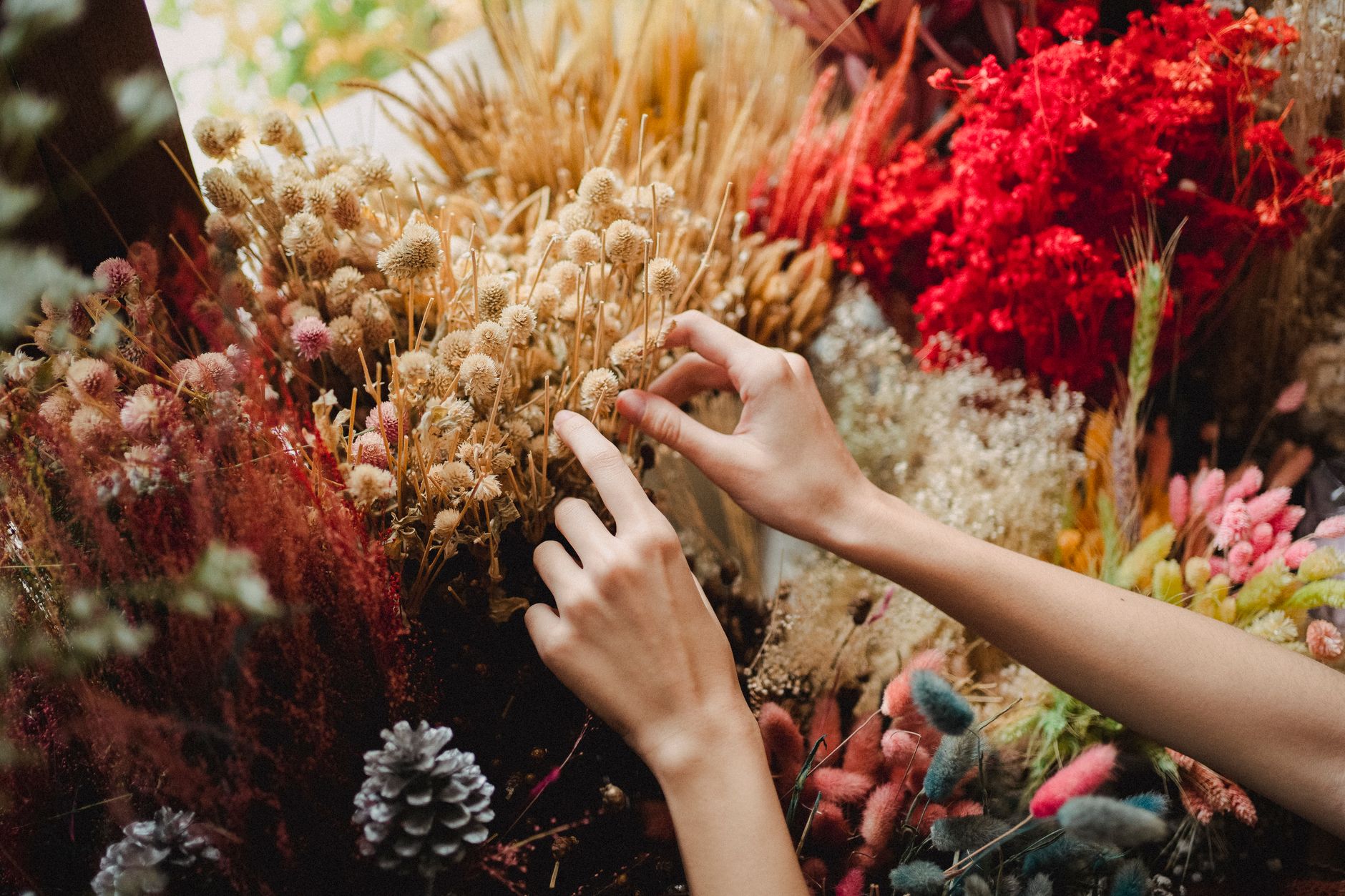
From November to March, the cooler months bring the widest range: dahlias in pink and deep purple, chrysanthemums in every tone, seasonal roses shipped south from Dalat's farms, and imported carnations. Late spring (April–May) is sparse; the heat stresses many species and imports become expensive. June through September, we rely on hearty tropical stems—heliconia, ginger flowers, tall grasses—and some chrysanthemums. This doesn't make off-season sessions worse; it makes them different. A July arrangement of bold orange heliconias and ferns feels entirely Vietnamese in character.
Ask in WhatsApp what's in bloom the week you want to visit; we send photos of that week's buckets.
How do we adapt for children, seniors, or people with no experience?
Children (ages 6+) work best with shorter, simpler tasks: a hand-tied posy in a small vase takes 45 minutes and keeps their focus sharp. We pre-cut some stems to manageable lengths and hand them safer, blunt-tip scissors. Teenagers and adults often want the fuller three-stem-type arrangement or two pieces.
Seniors appreciate a stool, a table at good height, and no rush. Arthritis? We pre-condition heavy stems and angle your vase so you're not straining your wrists. We've worked with people in their seventies and eighties; the real reward is their slowness and attention. They notice every leaf.
Allergies: tell us on WhatsApp. We avoid certain pollen-heavy flowers, work with windows open, and keep antihistamines on hand. We've hosted people with flower and dust sensitivities; it's not a barrier.
Why is an evening session different from a morning one?
The light changes everything. A morning session (8–10 a.m.) happens in bright, harsh clarity; you see every imperfection and the colours read sharp and clinical. An evening session, starting at 4 or 5 p.m., happens as the sun moves west: the studio fills with warm, diffused light that softens the reds and makes greens glow. Your arrangements look richer, less "craft-project" and more like something you'd buy from a proper florist. Psychologically, evening is slower. Morning brings rushed energy; by 5 p.m., guests settle. We also prefer evening because the studio's lanterns come on, and that kind of ambient light—soft, amber—is how Vietnamese families have arranged flowers for centuries. Morning is sharper and more educational; evening is meditative.
What to check before you book an evening session
- Confirm the date and time are truly available. Hoi An's tour and workshop calendar fills fast, especially Thursday–Sunday. We coordinate on WhatsApp and confirm 48 hours before.
- Ask what's in bloom that week and whether the style suits you. Show us a photo of an arrangement you like—formal, wild, minimalist—and we'll tell you honestly whether that season's blooms will let us teach you that approach.
- Clarify if the price includes take-home wrapping and a drink. Some evening sessions include tea or water; others don't. Ask.
- Mention allergies, mobility needs, or if you're bringing young kids. We adapt, but we need to know upfront.
- Check the weather. Hoi An rarely floods, but heavy rain can delay bloom availability. If it's forecast, ask us—we'll either postpone or confirm that fresh flowers are still coming from local suppliers that day.
- If you want a specific colour scheme, tell us 5+ days early. We can't always source, say, all-white arrangements; seasonal blooms are what we work with.

How does this fit with other Cáo experiences in Hoi An?
Many guests combine an evening flower session with something else. Some pair it with Vietnamese cooking classes the next morning—you cook breakfast, arrange flowers that evening, and spend 24 hours inside local food and craft rhythms. Others book a street food and market tour earlier the same day to see where ingredient vendors set up, then return to flowers in the cooler hours. We've also had guests do a tea experience at 3 p.m., then flower arranging at 5 p.m.—the calm of tea bleeds into the focus of flowers.
For families with children, family-focused experiences often include arranging a small posy as a take-home craft, mixed with cooking or a countryside walk. For couples on a longer stay, a wellness and slow experience day—morning meditation or stretching, afternoon flower work—bookends well.
Each experience in Hoi An sits in the old quarter or nearby countryside, walking distance from lantern-lit restaurants and cafés. We coordinate the whole trip on WhatsApp so you're not juggling times and addresses.
Comparison: evening flowers vs. other hands-on workshops in Hoi An
| Experience | Duration | Best for | What you take home | Skill needed |
|---|---|---|---|---|
| Evening flower arranging | 2–3 hours | Couples, groups, visual learners, gift-givers | One or two arrangements | None |
| Vietnamese cooking class | 2.5–3.5 hours | Foodies, families, people who want to eat the result | One shared meal, a handwritten recipe card | None |
| Street food & market tour | 2–3 hours | Adventurous eaters, photographers, culture-curious | Full stomach, stories | None |
| Tea experience | 1.5–2 hours | Contemplative travelers, gift shoppers | Understanding of Oolong or dark-leaf ceremony | None |
| Craft workshops | 1.5–4 hours | Makers, artists, people who like tangible skill | Handmade item (lantern, pottery) | Varies widely |
Conclusion: Choose flowers if you want beauty and stillness; choose cooking for social energy and appetite; choose craft if you want a specific item to keep.
Real guest concerns—and what actually happens
"I'll kill the arrangement on the flight home." We wrap it in wet floral foam, newspaper, and plastic—the same method professional florists use. It survives 8+ hours in a suitcase. Wilting is cosmetic; the mechanics are solid.
"I have no eye for design; I'll feel stupid." We guide every step. You're not making art; you're learning a process. By the end, your arrangement looks like you made it with intention, because you did.
"Will it be just me, or will there be other people?" We run groups of 2–6. If you want private, we offer that; ask for a quote. Mixed groups are always interesting—a couple, a solo traveler, someone's friend visiting—and people help each other without pressure.
"What if I need the loo?" It's a family studio. The toilet is indoors, 20 steps away. No awkwardness.
"Will the host speak English?" Yes. All Cáo Experiences workshops are English-hosted.
How to book an evening session step-by-step
- Open WhatsApp and message us with your preferred dates (give 2–3 options) and group size.
- We reply within a few hours with available times and ask what's in bloom that week.
- You confirm the date and time; we send WhatsApp location pins and a prep list (what to wear, what we provide).
- 48 hours before, we confirm attendance and arrival time.
- You arrive 5–10 minutes early; we brief you and start.
There's no online booking form or payment upfront; we sort everything on WhatsApp. This keeps things flexible if the weather changes or you want to add a friend last-minute.

FAQ
Can I do an evening flower session in Hanoi or Ho Chi Minh City instead of Hoi An?
Yes. We run flower arranging workshops in Hanoi and Saigon too, with the same approach but different urban settings—a Hanoi studio in Ba Dinh, a Saigon studio in District 1. The Hoi An session is special because it's in the ancient town and the light is uniquely soft. Ask us where suits your trip best.
Do I need to bring scissors or any tools?
No. We provide all secateurs, floral foam, vases, and water containers. Just bring yourself and wear something you don't mind getting wet.
What if I'm allergic to pollen?
Tell us before you book. We can use low-pollen varieties (roses, carnations, some dahlias) and keep windows open. It's manageable; we've hosted people with significant allergies.
Can I do the workshop with my teenage kids?
Yes, from age 10 upward. Younger children (6–9) can do a simpler posy version. Teens often make two arrangements. Mixed-age groups work well because we adapt within the same session.
What happens if it rains the evening we've booked?
We've never had to cancel for rain. The studio is indoors. If heavy flooding is forecast, we'd reschedule or confirm the night before. Rain is rarely a blocker in Hoi An.
Is the arrangement I make suitable as a gift for someone at home?
Absolutely. If you want to make one for them while learning—not your own—we can arrange that. Or you make yours and take it home, gift it wrapped. Many guests do this and it arrives in good condition after a flight.
How much will the evening session cost?
Ask us for dates and a quote on WhatsApp. Pricing depends on group size, seasonal blooms, and whether you want tea or extras included. We'll give you a clear price before you commit. === Learn flower arranging | Ask about dates on WhatsApp
Ask about dates
Tell us the city, your dates and what you would like to try. We reply on WhatsApp in English with options and availability.
FAQ
Can I do an evening flower session in Hanoi or Ho Chi Minh City instead of Hoi An?
Yes. We run [flower arranging workshops](/flower-arranging) in Hanoi and Saigon too, with the same approach but different urban settings—a Hanoi studio in Ba Dinh, a Saigon studio in District 1. The Hoi An session is special because it's in the ancient town and the light is uniquely soft. Ask us where suits your trip best.
Do I need to bring scissors or any tools?
No. We provide all secateurs, floral foam, vases, and water containers. Just bring yourself and wear something you don't mind getting wet.
What if I'm allergic to pollen?
Tell us before you book. We can use low-pollen varieties (roses, carnations, some dahlias) and keep windows open. It's manageable; we've hosted people with significant allergies.
Can I do the workshop with my teenage kids?
Yes, from age 10 upward. Younger children (6–9) can do a simpler posy version. Teens often make two arrangements. Mixed-age groups work well because we adapt within the same session.
What happens if it rains the evening we've booked?
We've never had to cancel for rain. The studio is indoors. If heavy flooding is forecast, we'd reschedule or confirm the night before. Rain is rarely a blocker in Hoi An.
Is the arrangement I make suitable as a gift for someone at home?
Absolutely. If you want to make one for them while learning—not your own—we can arrange that. Or you make yours and take it home, gift it wrapped. Many guests do this and it arrives in good condition after a flight.
How much will the evening session cost?
Ask us for dates and a quote on WhatsApp. Pricing depends on group size, seasonal blooms, and whether you want tea or extras included. We'll give you a clear price before you commit. === 🌸 Learn flower arranging | [💬 Ask about dates on WhatsApp](https://wa.me/84338762340)
More like this
Flower arranging workshops
Flower Arranging Workshop Ho Chi Minh City: How to Book
A flower arranging workshop in Ho Chi Minh City teaches you to design seasonal arrangements in a calm studio setting. We run small-group and private sessions with English-speaking hosts who walk you through technique, flower choice, and how to make arrangements last.
Flower arranging workshops
Flower arranging workshop in Ninh Binh for couples
A flower arranging workshop in Ninh Binh lets couples create an arrangement together in a calm setting, learning Vietnamese design principles while working with seasonal blooms.
Flower arranging workshops
Flower Arranging Workshop in Mekong Delta for Foreigners
We run intimate flower arranging workshops in family-owned gardens and workshops across the Mekong Delta, where you'll learn seasonal design by practicing alongside our hosts. Pick your own blooms, arrange three pieces, and take them home.